
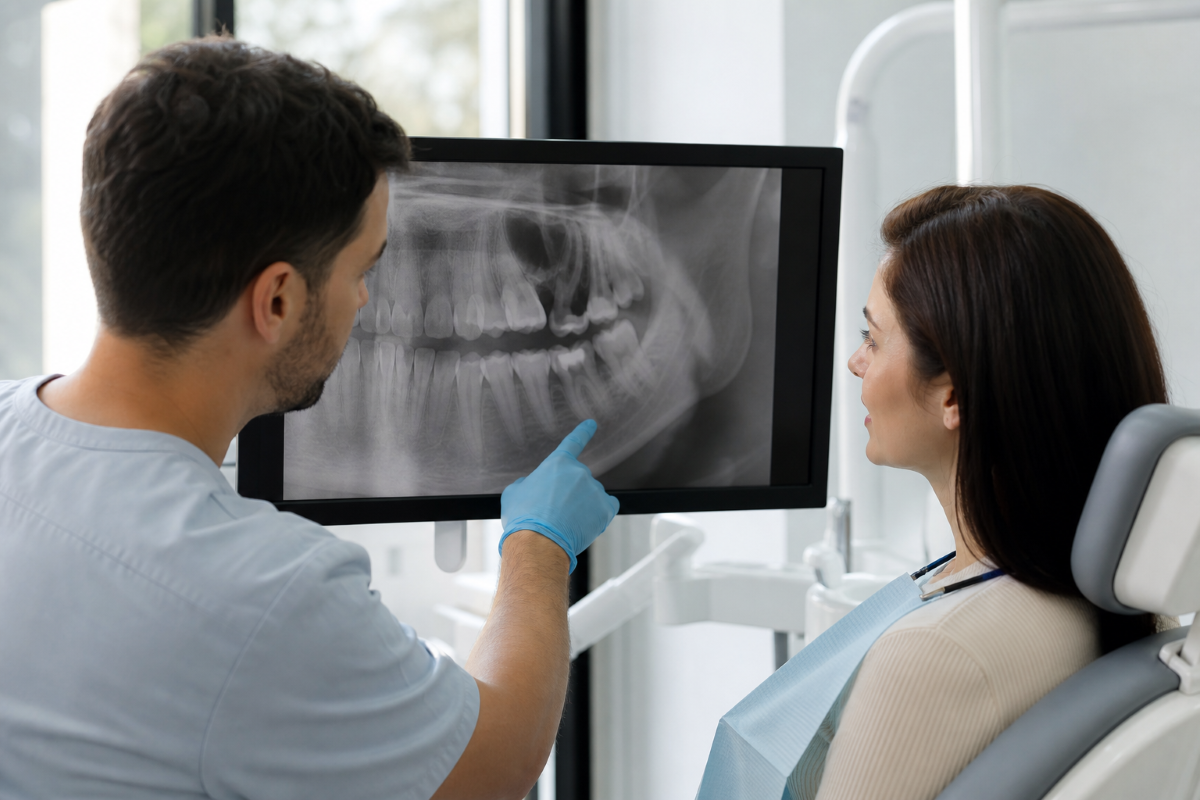
A tooth extraction is the removal of a tooth that cannot be saved, usually because of severe decay, damage, infection or advanced gum disease. It is also performed as part of orthodontic or restorative planning. The decision follows a clinical examination and imaging, and local numbing is used throughout.
What to Expect From Your Extraction
- The tooth is carefully loosened and removed by the dentist, with local numbing used to minimise discomfort.
- Most patients report pressure rather than pain during the procedure itself.
- Initial healing begins within 1 to 5 days, and full healing usually takes 1 to 2 weeks.
- Typical cost is $318 to $731 per tooth. Final pricing varies based on your individual clinical needs.
- Every patient receives a written aftercare instruction sheet covering tooth extraction aftercare in full.
- Replacement options, including bridges, dentures and implants, are discussed where a tooth needs replacing.
Removal is recommended after clinical examination and imaging, not from a look alone, and the reason is explained to you before anything is booked. Where the tooth is coming out, replacement is part of the same conversation rather than a separate problem for later.
When Is a Tooth Extraction Recommended?
Only when the tooth cannot reasonably be kept, or when you decide not to restore it. Removal is recommended in these situations:
- Severe decay or damage beyond repair, where dental extraction is the only remaining option
- Infection, or advanced gum disease affecting the tooth's support
- Orthodontic or restorative planning that requires the space
- As one treatment option where a patient chooses not to restore a severely compromised tooth with a root canal or a crown
When Removal Is a Choice Rather Than a Last Resort
Tooth removal is sometimes a legitimate choice rather than a last resort, and the alternatives are laid out so the decision is yours. Teeth removal for orthodontic spacing is planned in advance rather than done reactively. Every recommendation rests on clinical examination and imaging, not on assumption.
Simple or Surgical Extraction: What Is the Difference?
Both are explained to you beforehand where the distinction is relevant. A simple tooth extraction removes a tooth that is fully visible above the gum, while a surgical approach is used when it is not.
| Simple extraction | Surgical extraction | |
|---|---|---|
| Tooth position | Fully erupted and visible | Broken at the gumline, or below it |
| Access | Loosened and lifted out directly | Access created through gum tissue |
| Anaesthet ic | Local numbing | Local numbing, with dental sedation discussed where appropriate |
| Typical use | Decay, gum disease, orthodontic spacing | Fractured roots, impacted teeth, molar removal at depth |
| Recovery | Usually at the shorter end of 1 to 2 weeks | Often the longer end, depending on complexity |
Cost varies with complexity and tooth location, which is the main reason the range is as wide as it is.
Does Having a Tooth Removed Hurt?
Most patients feel pressure, not pain. Local numbing is used specifically to prevent pain during the procedure, and your comfort is monitored throughout rather than assumed.
Afterwards, expect mild to moderate soreness:
- Swelling or tenderness may occur temporarily
- Symptoms typically improve within a few days
- Pain management guidance is provided before you leave
- Day-three discomfort is normal, not a sign something has gone wrong
Why Day Three Feels Worse
Discomfort often peaks around day three rather than day one, and knowing that in advance saves an anxious phone call.
How Long Does Healing Take, and What Should You Avoid?
Initial healing begins within 1 to 5 days, and full healing usually takes 1 to 2 weeks. Tooth extraction healing depends heavily on what you do in the first 48 hours.
For the first two days:
- Do not spit, rinse, or use a straw
- Avoid smoking and strenuous activity throughout healing
For the first 12 hours, eat only soft, cold or room-temperature food. Smoothies, yogurt, ice cream and room-temperature soups all work well. For the first week, chew away from the extraction site.
Your Written Aftercare Sheet
You are given written instructions covering eating, rinsing and activity, so none of this has to be remembered from the appointment. According to the Canadian Dental Association, following post-operative instructions closely is central to uncomplicated healing.

How Much Does an Extraction Cost?
Typical tooth extraction cost runs from $318 to $731 per tooth. Final pricing varies based on your individual clinical needs.
- Cost varies with complexity and tooth location
- Insurance coverage is reviewed when applicable
- Costs are discussed before treatment begins
- Extractions are among the services covered under the Canadian Dental Care Plan, subject to CDCP approval and limits
Where a tooth needs replacing, bridge, denture and implant options are compared with you so you can weigh cost against longevity. dental implants and dentures each suit different situations.
Frequently Asked Questions
How long does recovery take?
What can I eat afterwards?
Why does it hurt more on day three?
Can I smoke after having a tooth removed?
Do I have to replace the tooth afterwards?
Is a molar extraction more difficult?
Will I get written aftercare instructions?
Book Your Consultation in Waterloo
An extraction is a decision, not just a procedure, and it should be made with the alternatives on the table. If you are looking for tooth extraction near you in Waterloo, the first step is an examination and imaging to confirm whether the tooth can be saved.
- Local numbing throughout, with comfort monitored during the procedure.
- Written aftercare instructions provided to every patient, plus replacement options compared afterwards.
Book an assessment before your tooth extraction and get the full picture first.
Westmount Dental 50 Westmount Rd N #225, Waterloo, ON N2L 2R5, Canada