
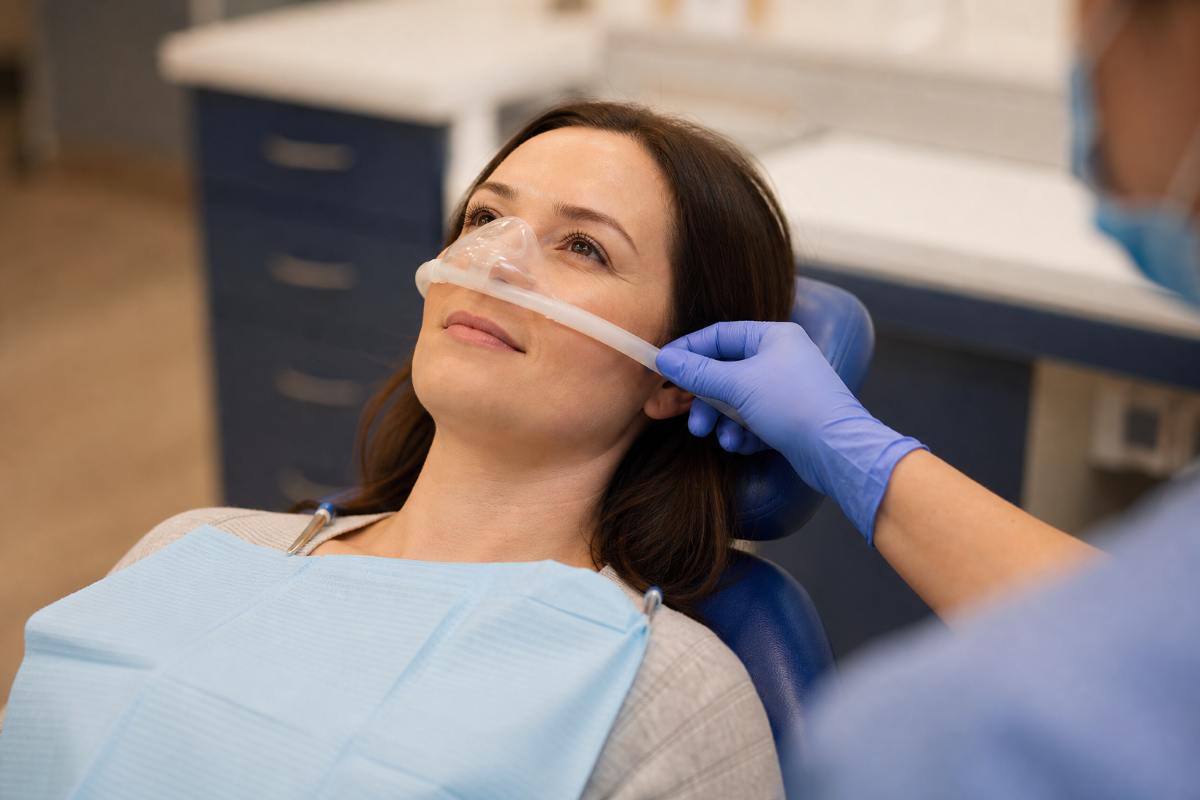
Dental sedation uses medication to help a patient feel relaxed during treatment, most commonly nitrous oxide or an oral sedative. Patients remain awake and responsive throughout, and the effects wear off shortly after the appointment. Suitability is assessed individually against medical history and the procedure planned.
What Sedation Looks Like Here
- Two options are offered: nitrous oxide, widely known as laughing gas, and oral sedation.
- Dr. Israa Al-Ani is licensed for minimal sedation and Dr. Mustafa Alani is licensed for moderate sedation, both by the Royal College of Dental Surgeons of Ontario (RCDSO), and both are trained for it.
- Dental sedation services are administered by trained dental professionals and supervised by the dentist.
- You stay awake and responsive the whole time.
- Sedation is recommended only where it is clinically appropriate, and alternatives are explained if they exist.
- Nitrous oxide sedation is among the services covered under the Canadian Dental Care Plan, subject to CDCP approval and limits.
If anxiety, a sensitive gag reflex or a long appointment is the barrier to treatment, sedation is the part of the plan that removes it. Which option applies, and whether it applies at all, is decided after your medical history has been reviewed rather than at the chair.
Anyone for whom the appointment itself is the obstacle. Sedation dentistry exists to remove that obstacle rather than to make treatment possible where it otherwise would not be.
- Patients with dental anxiety or outright fear of the dentist
- Longer or more complex procedures, where staying comfortable for the duration matters
- Patients with a sensitive gag reflex
- Children who find a visit distressing, covered further under pediatric dentistry
Suitability is assessed case by case. Dental sedation is not applied as routine, and it is not the answer to every nervous patient.
What Sedation Options Are Available?
Two, and they suit different situations. Oral sedation dentistry works by medication taken before the appointment, while nitrous oxide dental sedation is inhaled and adjusted during it. Oral sedation is sometimes called oral conscious sedation, because you stay awake throughout.
| Nitrous oxide (laughing gas) | Oral sedation | |
|---|---|---|
| How it is given | Inhaled through a small nasal hood during treatment | Medication taken in advance of the appointment |
| Awareness | Awake and responsive | Awake and responsive |
| Onset and control | Adjustable minute to minute during the visit | Set once taken, not adjustable mid- appointment |
| Wearing off | Shortly after treatment ends | Longer, so recovery expectations are discussed first |
| Driving afterwards | Eligibility explained at your appointment | Eligibility explained at your appointment |
| Suits | Anxiety, gag reflex, children | Higher anxiety, longer procedures |
Which one is recommended depends on your medical history, your age and health status, and the procedure planned. Options are always explained before treatment begins.
What Should You Expect Before, During and After?
You will know what is happening at every stage, because recovery expectations are discussed with you in advance rather than afterwards.
- Your medical history is reviewed before any sedation is given.
- Eating instructions are provided ahead of the appointment.
- Sedation is administered by trained dental professionals under the dentist's supervision.
- You remain awake and responsive, and are continuously monitored throughout.
- Effects wear off shortly after treatment for nitrous oxide.
- Driving eligibility is explained to you, and post-treatment instructions are provided.
Driving Afterwards
With nitrous oxide the effects lift shortly after treatment. With oral sedation they do not, which is why driving eligibility is discussed with you specifically rather than assumed, and why arrangements are agreed before the appointment.
Is Dental Sedation Safe for Children and Adults?
Safety rests on assessment and monitoring rather than on the drug itself being risk-free. Medical history is reviewed first, and the approach is tailored to age and health status.
- Medical history reviewed before sedation is given
- Sedation tailored to age and health status
- Continuous monitoring during treatment
- Post-treatment instructions provided
- Safety protocols followed at all times
Licensing and Credentials
Both sedating dentists here hold (RCDSO) licences for their respective sedation levels, which is the relevant credential in Ontario for moderate sedation dentistry as well as minimal. According to the Canadian Dental Association, discussing your full medical history with your dentist is central to safe treatment.

What Does Sedation Cost, and Is It Covered?
Your dental sedation cost is explained to you before treatment, and insurance coverage is reviewed where it applies. Final pricing varies based on your individual clinical needs.
- Costs are set out before anything proceeds
- Insurance coverage is reviewed when applicable
- Nitrous oxide sedation is covered under CDCP, subject to approval and limits
- Benefits and limitations are discussed openly, including what sedation will not do
When Sedation Is Not Recommended
Sedation is recommended only when clinically appropriate, so it is not offered for every appointment. Where an alternative exists, you are told about it, and the benefits and limits of each are set out openly.
Frequently Asked Questions
Will I be unconscious during dental sedation?
Can I drive myself home afterwards?
Do I need to avoid eating before sedation?
Is laughing gas suitable for a nervous child?
Who actually administers the sedation?
Can sedation be used for any treatment?
Book a Sedation Consultation in Waterloo
If anxiety is the reason you have been putting off treatment, that is a solvable problem and a common one. Whether you are looking for sedation dentistry near you in Waterloo, a sedation dentist near you, or simply want the options explained without committing, the conversation comes first.
- Two sedation options, with dentists licensed by the (RCDSO) for minimal and moderate sedation, so sedation for dental treatment is matched to the procedure.
- Continuous monitoring throughout, and recovery expectations explained before you agree.
Ask about dental sedation at your next appointment.
Westmount Dental 50 Westmount Rd N #225, Waterloo, ON N2L 2R5, Canada