

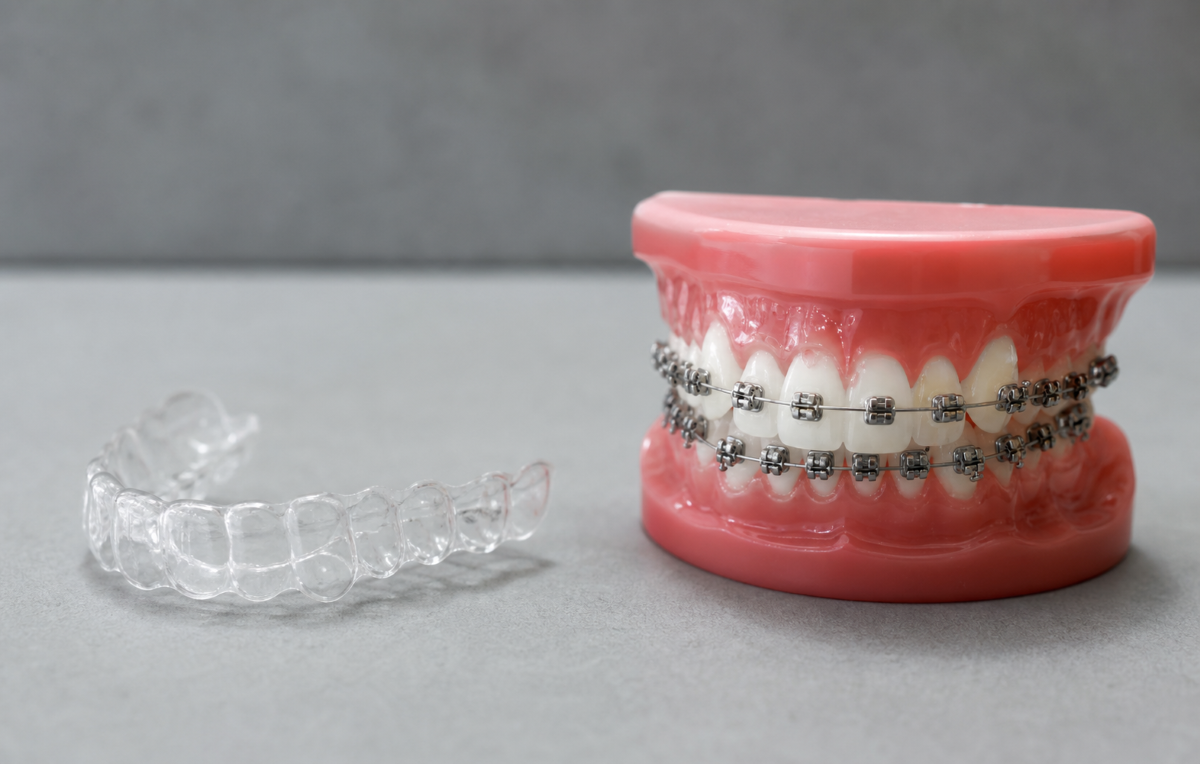
Aligners are removable and nearly invisible; braces work continuously whether you cooperate or not. Here is how to tell which one your teeth actually need.
Invisalign vs braces comes down to three things: how your teeth need to move, how visible you want treatment to be, and how disciplined you can be about wearing something. Aligners are removable and nearly invisible. Braces are fixed and work continuously. In Waterloo, both routes are assessed the same way, from a clinical examination.
The Short Version, Before the Detail
- Aligners are removable, braces are not. That single difference drives most of the others.
- Braces work whether you cooperate or not. Aligners only move teeth while they are in your mouth.
- Clear aligners are far less visible, which is why most adults ask about them first.
- Both need retention afterwards. Teeth drift back regardless of how they were straightened.
- At Westmount Dental in Waterloo, Invisalign treatment typically runs 8 to 14 months, costs $5,500 to $6,000, and includes refinements if the goals change along the way.
- The initial consultation and digital assessment are complimentary, so finding out which route suits you costs nothing.
Choosing between them is less about which product is better and more about which one fits the person wearing it. Where alignment is one part of a wider cosmetic plan, that belongs on the smile makeover page instead. A teenager who plays rugby, an adult in daily client meetings, and a patient whose teeth have drifted twenty years after childhood braces are three completely different decisions, even with similar-looking crowding.
Invisalign vs Braces: How Do They Actually Differ?
The invisalign vs braces decision starts with something both share: gentle, sustained pressure that moves teeth through bone. That part is identical. What differs is how the pressure is delivered, and what that means for your daily life.
Braces use brackets bonded to each tooth, connected by a wire that the dentist or orthodontist adjusts. Invisalign treatment uses a series of custom trays, each one shaped slightly differently from the last, worn in sequence.
| Invisalign | Traditional braces | |
|---|---|---|
| Visibility | Nearly invisible | Visible brackets and wire |
| Removable | Yes, for eating and cleaning | No, fixed until treatment ends |
| Depends on compliance | Yes, heavily | No, works continuously |
| Cleaning your teeth | Normal brushing and flossing | Brushing around brackets and wire |
| Food restrictions | Remove the trays and eat normally | Hard and sticky foods restricted |
| Emergency visits | Rare | Loose brackets and poking wires happen |
Where Braces Still Win
Fixed appliances are not the old-fashioned option. For some movements, particularly complex rotations or significant bite corrections, a fixed appliance gives the control that trays cannot. A dentist who tells you aligners can do absolutely anything is overselling.
Where Aligners Win
Removability is the practical advantage, and it goes beyond appearance. You brush and floss normally, which matters over a year of treatment, and you take the trays out to eat. The benefits of Invisalign for adults tend to be split that way: the invisibility is what starts the conversation, and the hygiene is what confirms it.
Invisalign vs Braces for Adults: Which Wins?
For most adult cases, is invisalign better than braces is really a question about visibility and lifestyle rather than clinical capability. Patients search it as braces vs invisalign just as often, and the answer runs the same way in both directions. Invisalign for adults is frequently chosen for discreet treatment, and one particular group arrives more often than people expect.
Teeth straightened in adolescence that have drifted since are called orthodontic relapse, and it is one of the commonest reasons adults start aligner treatment. It is often a shorter piece of work than the original braces were, because the teeth are being nudged back rather than moved for the first time.
- Discretion at work and in photographs
- Normal brushing and flossing throughout treatment
- No wires to catch, break, or need emergency attention
- Trays come out for a meal, a presentation, or a wedding
What About Teens?
Invisalign for teens is usually about not wearing metal brackets in every photograph for two or three years. The honest caveat is compliance: a teenager who leaves the trays in a school bag is not being treated. Braces remove that variable entirely, which is occasionally the better answer for the same set of teeth.
Which Problems Can Aligners Treat?
At this practice, aligner treatment is used for crowded or overlapping teeth, gaps and spacing, bite alignment issues, and orthodontic relapse after previous treatment.
- Crowded or overlapping teeth
- Gaps or spacing between teeth
- Bite alignment issues
- Orthodontic relapse after earlier orthodontics
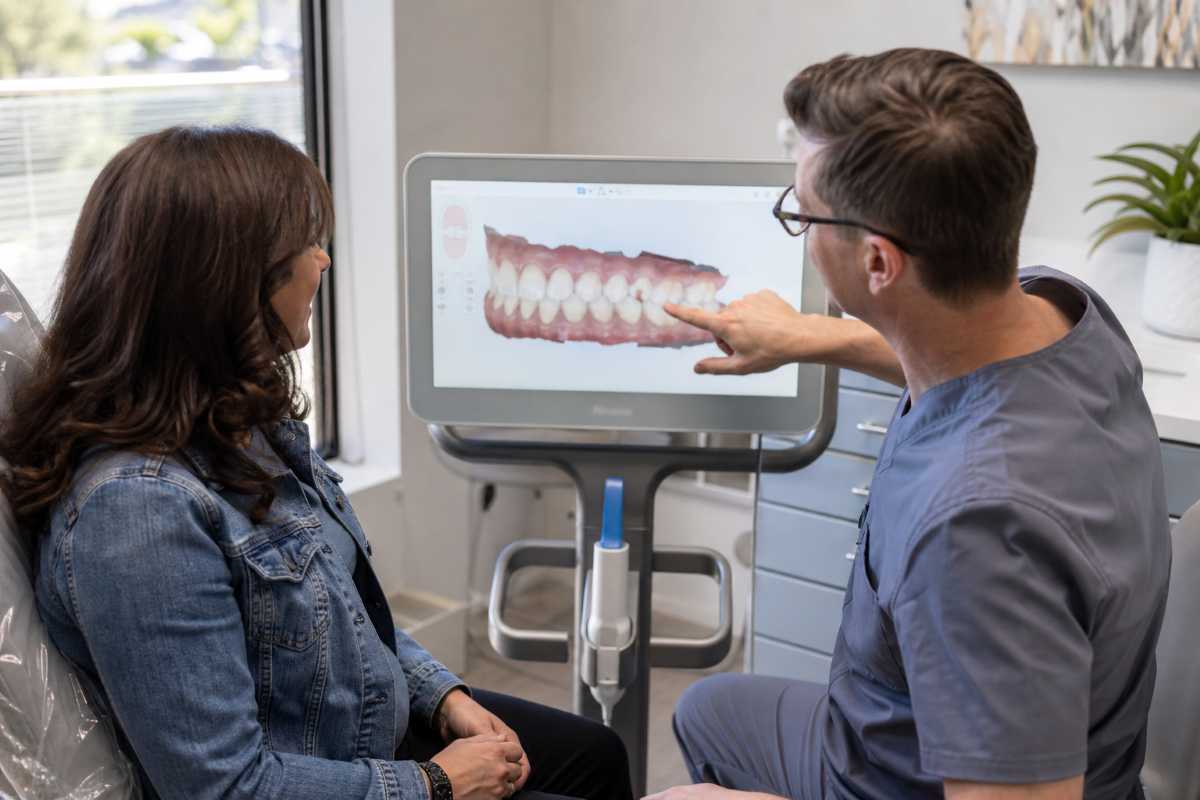
Whether a specific bite can be corrected with aligners is a case-by-case assessment rather than a general yes, and that is established at the digital assessment rather than promised beforehand. What that actually looks like in finished cases is covered in Invisalign before and after: what results really look like. According to the Canadian Dental Association, crowded and misaligned teeth are harder to clean thoroughly, which is why alignment is a health question as much as an appearance one.
How Long Does Treatment Take, Either Way?
Invisalign treatment here typically takes 8 to 14 months, varying with case complexity and with how consistently the trays are worn. Braces commonly run longer, often eighteen months to two years, though both figures depend entirely on what needs moving.
Three things stretch an aligner timeline:
- Complexity. More movement takes more trays.
- Compliance. Aligners only work while they are in your mouth, and inconsistent wear extends the treatment.
- Refinements. Where the result needs fine-tuning, additional aligners are made, which adds time.
Refinements are included here if treatment goals evolve, which matters more than it sounds. Cases do not always finish exactly where the original plan predicted, and additional trays to close that gap are part of the treatment rather than a new invoice. Your timeline is reviewed with you before treatment begins, not estimated afterwards. There is more detail in how long Invisalign takes and what makes it longer, and the full service detail sits on the Invisalign service page.
What Does Each Option Cost?
Invisalign cost at Westmount Dental in Waterloo is $5,500 to $6,000, varying with case complexity. Braces vary widely by provider and case, so any comparison you read online is a range against a range rather than a like-for-like quote.
- Orthodontic insurance benefits are reviewed with you, and what may be covered versus out of pocket is explained
- An estimate is sent to your insurer for pre-approval before treatment starts
- Payment plans at 0% interest spread the cost over 12 months
- A personalised estimate follows the assessment, not a phone call
The pre-approval step is the useful part. Sending the estimate before treatment begins means you are not discovering a coverage gap halfway through a year of aligners, and how Invisalign works with dental insurance goes through that process properly.
Who Should Oversee It?
This is the part patients skip, and it matters more than the brand of tray. Treatment here is planned and overseen by Invisalign-certified dentist Dr. Israa Al-Ani, with advanced experience in the system, and cases are monitored with regular in-person visits rather than remotely.
That distinction is worth pressing on, because a large part of the aligner market now runs by post and app. Progress checked in the chair is where a tooth that is not tracking as planned gets spotted, while there is still time to adjust the plan rather than restart it.
What Happens When Treatment Ends?
Whichever way the invisalign vs braces question lands, both routes end the same way: retention. Teeth move throughout life, and without a retainer they drift back toward where they started. A retention plan is discussed once active treatment is complete, and retainer options form part of that plan.
If you have had braces before and your teeth have shifted since, that is not a failure on your part. It is what teeth do when retention stops, and it is the single most common reason adults return for a second round of treatment.
Common Questions About Invisalign vs Braces
Is Invisalign better than braces?
Neither is universally better. Aligners are removable, nearly invisible and easier to clean around, which suits most adult cases. Fixed braces work continuously regardless of compliance and give more control over certain complex movements. The right answer depends on your teeth, your bite and your habits, and it is established at an assessment.
Can Invisalign fix an overbite or underbite?
Bite alignment issues are among the concerns treated with aligners, but whether a specific bite can be corrected that way is a case-by-case judgement rather than a general yes. Some bites respond well to aligners, others are better served by fixed appliances or a combined approach, and imaging at the digital assessment is what settles it.
How long does Invisalign take compared to braces?
Aligner treatment at this practice typically takes 8 to 14 months. Braces commonly run longer, often eighteen months to two years, though both depend on the case. Complexity, how consistently you wear the trays, and any refinements all affect the aligner total.
Does Invisalign hurt less than braces?
Both work by applying pressure, so both cause some discomfort, particularly in the first days of a new tray or after a wire adjustment. Aligners avoid one specific problem that braces have: there are no brackets or wires to rub the inside of the cheek or need an emergency appointment.
Do I need a retainer after either treatment?
Yes, after both. Teeth shift throughout life, so a retention plan is discussed at the end of active treatment and retainer wear is what protects the result. Skipping retention is the usual reason patients who had braces as teenagers need treatment again as adults.
Not Sure Which Route Your Teeth Need?
That is exactly what the first appointment is for, and at this practice it costs nothing.
- The initial consultation and digital assessment are complimentary, so you can find out where you stand before committing to anything.
- Treatment is planned and monitored in person by an Invisalign-certified dentist, not by post or app.
- If aligners suit your case, you get a personalised estimate, a reviewed timeline, and 0% payment plans over 12 months before you decide.
Call Westmount Dental in Waterloo on 519-578-2720, or book a complimentary assessment at 50 Westmount Rd N #225, and bring your questions about both options.
Westmount Dental, 50 Westmount Rd N #225, Waterloo, ON N2L 2R5, Canada