

What aligner results actually look like, what a before and after photo cannot tell you, and how a digital assessment predicts your own outcome.
Invisalign before and after photographs show what aligners changed and, just as usefully, what they did not. Most cases involve crowding, spacing, or teeth that drifted after childhood braces. Results depend on the starting position, the complexity of the movement, and how consistently the trays were worn in Waterloo.
What to Look For in a Results Photo
- Crowding unwinding, so overlapping front teeth sit in a row rather than in front of each other.
- Gaps closing, which is often the fastest visible change.
- Relapse reversed, where teeth straightened years ago have drifted back.
- Bite alignment changes, which are the hardest to see in a photo and often the most important clinically.
- What did not change: the colour of the teeth, the shape of existing fillings or crowns, and the gum line.
Every set of photos on this site is from a real patient of the practice, used with consent.
That last point deserves saying plainly, because a lot of what circulates online does not meet it. A results photo is only useful if it comes from the practice you are considering, shows a case like yours, and has not been retouched. Anything else is decoration.
Invisalign Before and After: What Changes Are Visible?
Aligners move teeth. They do not whiten them, reshape them, or change the gums, and understanding that boundary is the difference between being pleased with a result and being disappointed by it. If you are still deciding between appliances rather than looking at outcomes, start with Invisalign vs braces instead.
Photographs at this practice reflect the concerns aligners are used for here: crowded or overlapping teeth, gaps and spacing, bite alignment issues, and orthodontic relapse after earlier treatment.
Crowding
Crowding is where the visible change tends to be most dramatic. When there is not enough room in the arch, teeth rotate and overlap to fit. As space is created and the rotations unwind, the front teeth come into line and the smile looks wider, even though no tooth has been added or removed.
Gaps and Spacing
Spaces close faster than most patients expect, and this is often the change people notice first in their own progress photos rather than at the end. It is also the change that most needs retention afterwards, because a space that was closed will try to reopen.
Relapse After Childhood Braces
This is the quiet majority of adult cases. Teeth straightened at fifteen that have shifted by thirty-five are not a failure of the original treatment; they are what teeth do when retention stops. Before-and-after photos in these cases often show a smaller change than a first-time case, because the teeth are being nudged back rather than moved from scratch.
What a Photo Cannot Tell You
Three things, and they matter when you are comparing one clinic's gallery with another's.
- Whether the case is like yours. A mild crowding case and a significant bite correction look superficially similar in a thumbnail and are entirely different pieces of treatment.
- How long it took. A photograph has no timeline. The same visible result might be eight months of work or twenty.
- Whether the result held. A photo taken the day the last aligner came out says nothing about where those teeth are two years later, which is entirely down to retention.
According to the Canadian Dental Association, teeth can continue to shift throughout adult life, which is why the honest version of any results photo includes what happens after treatment ends.
Can You See Your Own Result Before You Start?
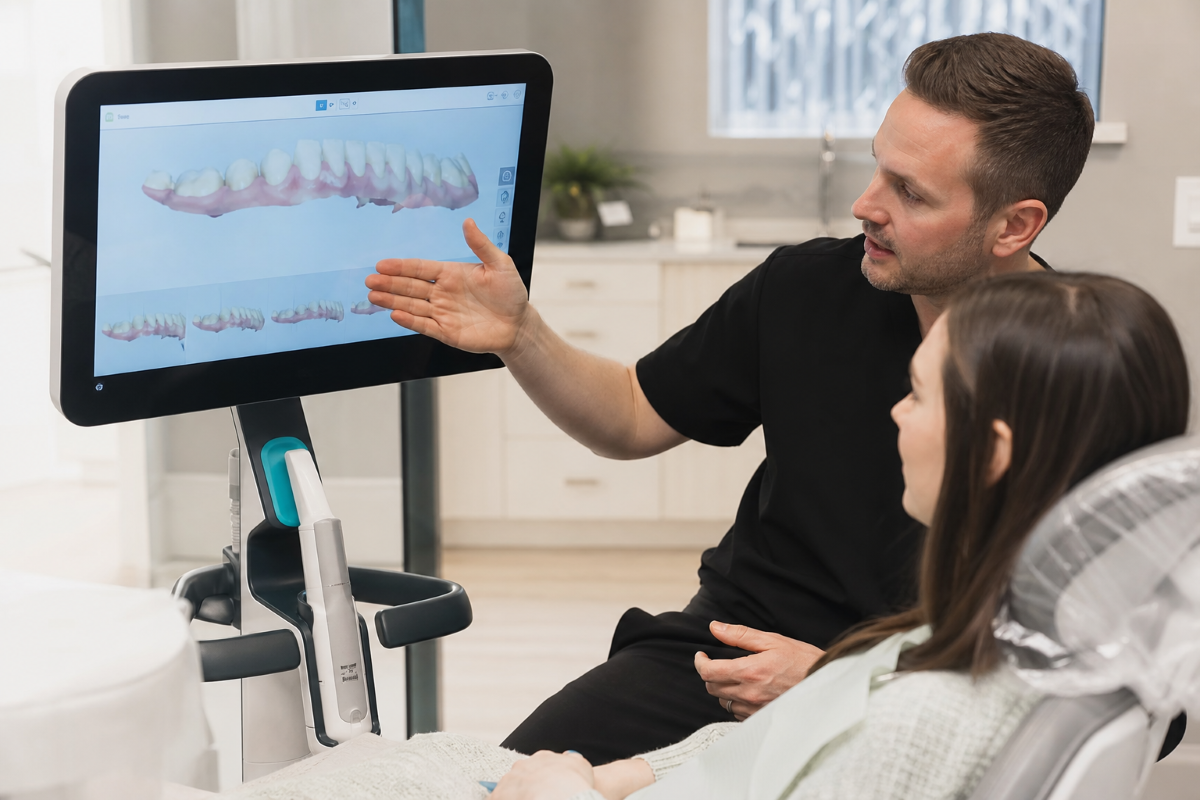
To a useful degree, yes, and this is more helpful than looking at anyone else's photographs. Treatment here begins with a complimentary initial consultation and digital assessment, and that assessment is what establishes whether aligners suit your case at all.
- Your case is assessed against what aligners can realistically achieve
- Suitability is discussed openly, including where a fixed appliance would do better
- The timeline is reviewed before treatment begins
- A personalised estimate follows the assessment
A digital plan built from your own teeth is a far better predictor of your outcome than a gallery of strangers. It also lets you ask the more useful question: not "can aligners do this in general" but "what would they do for me, and what would they leave untouched".
How Long Until You See a Difference?
Sooner than the end of treatment. Because each tray moves the teeth a small amount, change accumulates gradually, and most patients notice something within the first couple of months, particularly where spacing is involved.
Invisalign treatment at Westmount Dental typically runs 8 to 14 months, varying with case complexity and with how consistently the trays are worn. Two identical starting positions can finish months apart for that reason alone.
Refinements are included here if the treatment goals change along the way. Cases do not always finish exactly where the original plan predicted, and additional aligners to close that gap are part of the treatment rather than a new invoice. There is more on this in how long Invisalign takes and what makes it longer.
What Happens to the Result Afterwards?
It needs protecting, and this is the part that decides whether your own before-and-after still looks like the "after" in five years.
A retention plan is discussed once active treatment is complete, and retainer wear is what holds the teeth where the aligners put them. Skipping it is precisely why so many adults arrive asking about aligners a second time, having had braces as teenagers.
- Retention is part of the treatment, not an optional extra afterwards
- Teeth shift throughout life, with or without previous orthodontics
- Your dental exams continue as normal, so the result is monitored over time
Whose Invisalign Before and After Photos Should You Trust?
A short checklist, and it applies to any clinic including this one.
- Real patients of that practice, not stock imagery or manufacturer marketing
- Consent given for the images to be published
- Unretouched, with consistent lighting and angles between the before and the after
- Comparable cases, so you are looking at something resembling your own teeth
If a gallery cannot satisfy those four, it is telling you very little. Where alignment is only part of what you want changed, a combined plan may be the better conversation, and that sits on the smile makeover page.
Common Questions About Invisalign Results
How dramatic are Invisalign before and after results?
It depends almost entirely on the starting position. Significant crowding produces the most visible change, because rotated and overlapping teeth coming into line alters the whole appearance of the smile. Closing a single space is a smaller visible change, though often the one a patient most wanted. Bite corrections can be clinically important and barely visible in a photograph.
Does Invisalign change the colour of your teeth?
No. Aligners move teeth and do nothing to their colour. If whitening is also part of what you want, it is a separate treatment and it is usually sequenced after alignment, since straight teeth whiten more evenly. This practice provides dentist-prescribed take-home whitening kits rather than in-office bleaching.
Can I see a preview of my own results?
Yes, in the practical sense. The initial consultation and digital assessment are complimentary here, and that assessment establishes whether aligners suit your case, what movement is realistic, and how long it would take. That is a better predictor of your outcome than any gallery.
Are before and after photos of real patients?
They should be, and at this practice they are, published with patient consent and unretouched. Any clinic showing stock images or manufacturer marketing as its own results is telling you nothing about the treatment you would receive.
Will my results last?
Only with retention. A retention plan is discussed at the end of active treatment, and wearing the retainer is what holds the result. Teeth shift throughout adult life, so relapse after stopping retention is common and is one of the main reasons adults start aligner treatment in the first place.
Want to Know What Aligners Would Do for Your Teeth?
Looking at other people's results only takes you so far. The useful answer comes from your own teeth.
- The initial consultation and digital assessment are complimentary, so finding out what is realistic costs nothing.
- Treatment is planned and monitored in person by Invisalign-certified dentist Dr. Israa Al-Ani, not remotely by app.
- If aligners suit your case, you get a reviewed timeline, a personalised estimate, and 0% payment plans over 12 months before deciding.
Call Westmount Dental in Waterloo on 519-578-2720 or visit 50 Westmount Rd N #225 to book your assessment, and ask to see cases similar to yours.
Westmount Dental, 50 Westmount Rd N #225, Waterloo, ON N2L 2R5, Canada